
Every IT strategy depends on one thing above all: clarity. You can’t make confident decisions about budgets, resilience, or cloud migration if you don’t know exactly what services your organisation is relying on.
That’s why a service catalogue is so important.
In ITIL terms, a service catalogue is a structured record of the services IT provides to the business. But in practice, the most effective way to build one is to begin with a deceptively simple question:
“What services do our users think IT delivers?”

Why the user perspective matters
When you ask this question, you’ll often uncover things IT didn’t know about. It could be shadow IT — tools or platforms bought without approval. Or it could be user-created solutions that quietly become critical, like a spreadsheet designed years ago to track something that an entire department still depends on.
By starting with the user view, you reveal the real services the business is running on — not just the ones IT thinks it owns. From there, you can connect each service to its technical dependencies: software, infrastructure, cloud platforms, and data.
This dual perspective — business-facing and technical — is what transforms a service catalogue from a static document into a strategic asset.
What a service catalogue should include
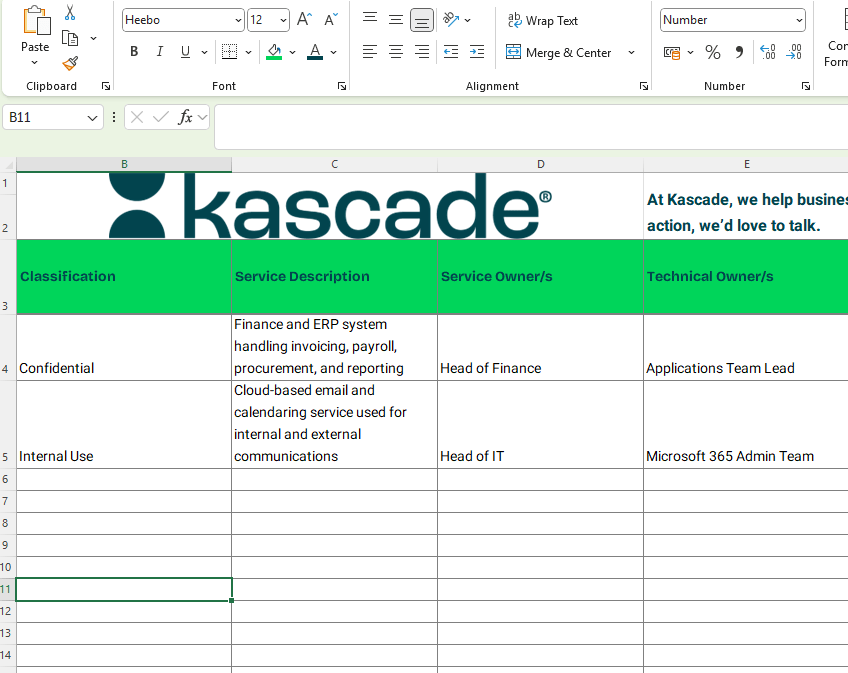
At its most basic, a service catalogue should capture:
- Service name – written in business-friendly language.
- Description – what the service does and who uses it.
- Dependencies – underlying VMs, infrastructure, software, and integrations.
- Service owners – both technical leads and business contacts (who you’d call to test a change).
- RPO (Recovery Point Objective) – how much data loss is tolerable.
- RTO (Recovery Time Objective) – how quickly the service must be restored.
As your catalogue matures, you can extend it with:
- Flags for confidential or regulated data.
- Next refresh dates (to support budgeting cycles).
- Security and incident response notes (e.g. playbooks for sensitive services).
- Cloud migration “next step” fields, such as retire, move to SaaS, migrate to Azure VM.
From static list to strategic tool
A well-maintained service catalogue unlocks real strategic value for IT leaders:
- Data protection and resilience – Validate whether current backup and DR solutions meet the needs of each service. Are RPOs and RTOs realistic and tested?
- Security and compliance – Identify where confidential data sits and ensure incident response plans and controls cover those services.
- Budgeting and planning – Link service refresh cycles to financial planning. Work with your CFO to build a multi-year view of investment, avoiding sudden surprises.
- Cloud migration roadmaps – Use the catalogue to plan which services can be retired, re-platformed, or modernised.
- Strategic conversations – Move the discussion with business stakeholders from “What do we have?” to “Where do we want to go?”
Start simple, then evolve
One reason many organisations hesitate is that they imagine a complex system or tool is required. In reality, the best approach is to start simple – even with an Excel spreadsheet. Capture what you know, accept that it won’t be perfect, and improve it over time.
The key is to treat the service catalogue as a living document. Out-of-date catalogues are worse than none at all, so regular reviews should be part of your IT governance cycle
Download our service catalogue example
To help you take the first step, we’ve created a straightforward service catalogue template you can adapt for your organisation. It covers the essentials, with space to grow as your catalogue matures.